Confirmation
Download PDF
Open All
A09: Non-Conveyance & Refusal of Care
Updated:
Reviewed:
Introduction
Non-conveyance refers to situations where a patient assessed by BCEHS paramedics is not transported to hospital, either by the patient’s informed personal choice or through clinical referral to an alternative clinical pathway.
Essentials
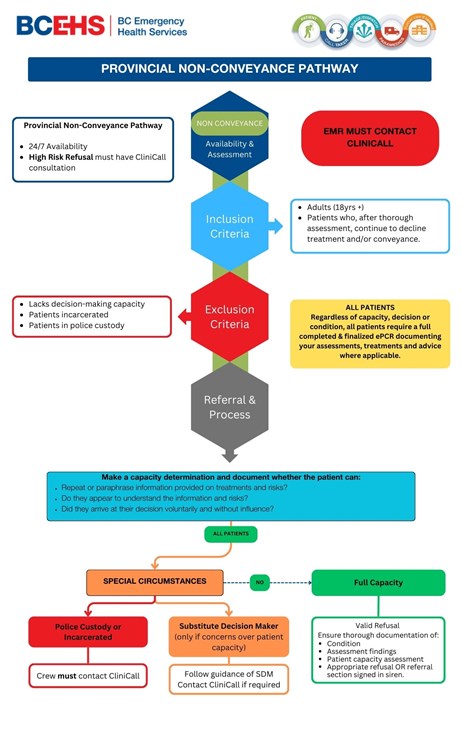
- Documentation must clearly explain the rationale for non-conveyance, this should include clinical findings, advice given, details of the patient’s capacity to refuse care, and whether the decision was supported by CliniCall consultation for high-risk refusals.
- Patients in police custody are considered a vulnerable population. CliniCall consultation is mandatory in non-conveyance of patients in police custody. Independent medical decisions may be limited due to their restricted freedom and dependency on authorities. Regardless of condition, patients in police custody retain the right to consent to or refuse healthcare.
- Clinical assessment is required to help a patient (or substitute decision maker) make an informed decision. This includes a primary and secondary survey, relevant history, vital signs (multiple sets if appropriate), and relevant clinical tools such as NEWS2. Uncertainty or ‘red flags’ should prompt the encouragement of transport and consultation with CliniCall.
- It is important to distinguish between capacity and competency. Capacity refers to a patient’s ability to understand and appreciate information relevant to a healthcare decision, and is assessed clinically by paramedics at the time of care. Competency, is a legal determination made by a judge. This guideline focuses exclusively on capacity, as it is the relevant standard for prehospital decision-making.
- Alternative care pathways should be clinically appropriate and accessible. Paramedics must confirm that the alternative pathway is suitable, available, and understood by the patient.
- Communication with family, caregivers, or other healthcare providers should be considered if appropriate and with the patient’s consent. This helps support continuity of care and ensures that someone is aware of what to watch for in case the patient deteriorates.
- Follow-up advice must be specific and documented. Patients should be advised how and when to seek help and advised to call 911 again or 811 if symptoms worsen or new concerns arise.
Referral Information
Referral to relevant Clinical Practice Guidelines (CPGs) and Alternative Clinical Pathways should be utilized as region-specific resources.
General Information
- Non-conveyance refers to any situation where paramedics assess a patient but do not transport them to hospital. This may result from patient refusal, care pathways like ASTaR, or referral to another service. While not inherently unsafe, non-conveyance requires thorough clinical assessment, supported decision-making, and robust documentation.
- Every patient has the legal right to refuse transport after being fully informed of their options. Non-conveyance decisions must be approached diligently, as they carry risk to patient outcomes. Patients should be fully informed, clinically assessed as allowed, and where appropriate, connected to follow-up care or safety-netting resources; this includes reading and confirming the refusal of care waivers within siren.
- It's essential to distinguish between a refusal of care and a clinically appropriate alternative plan. Guidelines, consultation, and structured pathways help ensure decisions respect both patient autonomy and safety.
- Under the Mental Health Act, the HCCCFAA, and ethical obligations, paramedics must assess a patient's capacity to make informed decisions. Confusion or cognitive impairment (e.g., dementia, brain injury) does not automatically mean incapacity. Capacity assessments focus on two elements: understanding relevant healthcare information and appreciating the consequences of decisions. This is a clinical judgment made by paramedics in the moment, distinct from legal ‘competency', which is determined by courts.
- If an adult lacks capacity and there’s no Advance Directive or Representation Agreement, consent should come from a Substitute Decision Maker (SDM). Prior documentation isn’t required to identify an SDM, who is prioritized by law: spouse, adult child, parent, sibling, grandparent, grandchild, adult relative, close friend, or in-law.
- For pediatric patients, non-conveyance requires ☎️ CliniCall consultation. Capacity in minors is not age-based but depends on their understanding of the proposed treatment and its risks. Young children may struggle to express symptoms.
- Conveyance should be encouraged if there's clinical uncertainty, concern about follow-through, or social risk factors; such as living alone, poor mobility, or lack of transport or phone access.
Engaging with Indigenous Patients
Paramedics should be aware of culturally safe and appropriate approaches when engaging with Indigenous patients. This includes applying wise practices—culturally appropriate actions, tools, and decisions that respect Indigenous values and autonomy. In alignment with the principles of Free, Prior, and Informed Consent (FPIC) as defined in the United Nations Declaration on the Rights of Indigenous Peoples (UNDRIP), consent should be:
- Free: Given voluntarily and without coercion.
- Prior: Sought in advance of procedures (not always practical in prehospital care, but the principle remains important).
- Informed: Based on accurate, objective information presented in a language and manner understandable to the patient.
-
Due to historical coercion in health care (e.g., sterilization of Indigenous women, nutrition experiments in residential schools), some Indigenous patients may not fully understand that consent is a patient-led decision. It is essential to explain that the decision rests with the patient, not the provider.
Consent must be culturally safe to be meaningful. Addressing power imbalances, racism, and mistrust is critical, as fear or mistrust can undermine true informed consent.
All care for Indigenous patients must follow free, prior, and informed consent, guided by cultural safety and supported by Indigenous-led mechanisms (FNHA guidance; In Plain Sight).
Key Principles:
- Cultural Safety: Recognize and address systemic racism, historical trauma, and power imbalances that may affect consent.
- Autonomy and Choice: Patients have the right to make decisions freely, without coercion, and can withdraw consent at any time.
- Indigenous-led Supports: Offer Elders, Knowledge Keepers, or patient advocates to guide consent discussions, as appropriate.
- Transparency: Provide clear, accessible information on the procedure, risks, benefits, and alternatives.
Interventions
First Responder (FR) Interventions
Autonomous non-conveyance is not applicable to First Responders.
Emergency Medical Responder (EMR) & All License Levels Interventions
- ☎️ CliniCall consultation required prior to non-conveyance of pediatric patients or patients in police custody, regardless of medical condition.
- With consent, conduct primary and secondary assessment. Consider relevant ASTaR pathways.
- Evaluate and document the patient’s capacity to make an informed decision regarding their care and transport.
- Discuss the risks and benefits of non-conveyance with the patient (and family or caregiver if appropriate), including a safety plan for worsening symptoms.
- If referring to an alternative care provider (e.g., Virtual Physician, UPCC, family doctor, Community Paramedic):
- Confirm the referral is accepted or follow the established referral process
- Provide the patient with written or verbal instructions for follow-up care.
- Obtain refusal or referral signatures from the patient and attending crew on the ePCR.
- Complete appropriate documentation.
Algorithm
References
- BCEHS Clinical Practice Guidelines – A01 Clinical Approach
- BCEHS Clinical Practice Guidelines – A04 Duty of Care
- BCEHS Clinical Practice Guidelines – A06 Documentation Standards
- BC Ministry of Health. In Plain Sight: Addressing Indigenous-specific Racism and Discrimination in BC Health Care. 2020.
- College of Physicians & Surgeons of BC. Professional Standards and Cultural Safety Guidance.
- EMA Regulations –Code of Ethics
- FNHA. Coercion and Consent: A Health-Care Provider’s Guide. 2023.
- Government of British Columbia –Adult Guardianship Act
- Government of British Columbia – Health Care (consent) and Care Facility (Admissions) Act