Confirmation
Download PDF
Open All
E07: Nausea and Vomiting
Updated:
Reviewed:
Introduction
By definition, nausea is the unpleasant and queasy sensation with or without an urge to vomit, while vomiting is the forceful expulsion of stomach contents.
Essentials
- Attempt to identify and resolve the underlying cause. Nausea and vomiting are not considered diseases on their own but rather a symptom of another condition. There are many potential causes of nausea and vomiting requiring complete assessment and history to differentiate possible causes.
- Vomiting can induce dehydration and metabolic derangements. Dehydration can occur as a result of fluid loss or lack of intake.
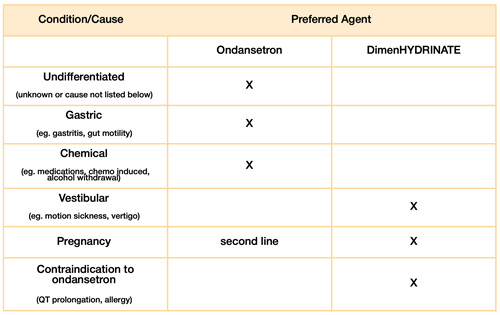
- Provide therapy to manage the symptom even when the underlying cause cannot be addressed. Nausea and vomiting are distressing symptoms, and it is reasonable to treat the symptoms even when the underlying causes cannot be addressed.
- Use the least invasive option where possible. Mild nausea and vomiting can be managed with oral medications, where moderate to severe nausea and vomiting is better managed with parenteral medications.
- Use an alternative agent if the first line is ineffective: A single agent is effective in most patients. If the first line agent is ineffective after 15-30 minutes, it is reasonable to consider providing a second antiemetic.
General Information
High risk causes of nausea and vomiting may include, but is not limited to:
- F03: Stroke
- Meningitis
- Gastrointestinal bleeding
- Ischemic bowel
- Diabetic ketoacidosis
- Overdose or drug toxicity
- Carbon monoxide poisoning
Low risk causes of nausea and vomiting may include, but is not limited to:
- Vertigo: sensation of spinning or whirling caused by inner ear disturbances
- Migraines: typically associated with one sided throbbing pain as well as light and sound sensitivity
- Medications: (eg opioids, newly started medications):
- Pregnancy: most common in the first trimester and in the morning but it can happen throughout the day and at any time during the course of pregnancy.
Interventions
First Responder (FR) Interventions
- Keep the patient at rest in a position of comfort
- Maintain patient in position of comfort consistent with the need to protect the patient’s airway
Primary Care Paramedic (PCP) Interventions
- Consider vascular access
- Manage shock
Critical Care Paramedic (CCP) Interventions
Algorithm
Practice Updates
- 2023-09-29: added ondansetron to PCP interventions