Confirmation
Download PDF
Open All
M09: Neonatal Resuscitation
Updated:
Reviewed:
Introduction
Neonatal resuscitation focuses on the respiratory system and transitioning from fetal circulation (oxygenation through the placenta and umbilical vein) to neonatal circulation (oxygenation through pulmonary vasculature). A functioning respiratory system is necessary to deliver oxygen to the lungs to produce pulmonary vasodilation which lowers pulmonary vascular resistance. When combining lower pulmonary vascular resistance with increased systemic vascular resistance, closure of fetal shunts and lung perfusion occurs.
Essentials
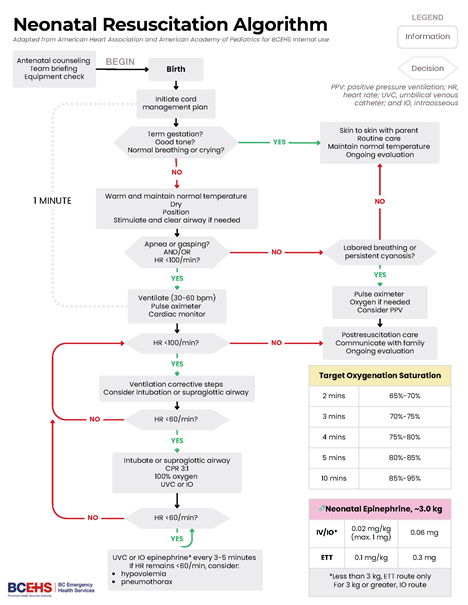
- The Neonatal Resuscitation Program (NRP) algorithm is below. Review Interventions section for Operational Scope of Practice as related to this algorithm.
- Effective oxygenation and ventilation are the hallmark of care in neonatal resuscitation. SpO2 should be monitored at the right hand as the best marker of preductal oxygenation.
- Advanced airways include both supraglottic airways and endotracheal tubes. Supraglottic airways are an effective, non-inferior alternative to endotracheal intubation.
- Hypothermia is a significant contributor to mortality. Early prevention of heat loss and warm ambient temperatures help prevent hypothermia. Hypothermia is concerning for all gestational ages of newborns, with low-birth weight (LBW) infants being at greatest risk.
- Routine oral, nasal, and endotracheal suction is no longer recommended. It is appropriate to suction frank meconium when visualized, and to suction more thoroughly when birthed non-vigorous.
- Delay cord clamping for at least 60 seconds for all patients. Drying, tactile stimulation, and initial evaluation of airway, breathing, and heart rate should all occur during this delay period.
- Resuscitation should be initiated for any neonate demonstrating signs of life or when the EGA is believed to be above 22 + 0. Decisions regarding discontinuation of resuscitative efforts are complex and should be made collaboratively, in consultation with CliniCall and in partnership with the family, with careful consideration of clinical context and goals of care.
Referral Information
All neonates requiring resuscitation should be conveyed to the closest appropriate birthing center hospital as per local destination guidelines.
General Information
- In normal fetal circulation transition, blood which had shunted normally in the fetus from the right side of the heart to the left side of the heart now needs to follow the regular blood flow pattern of extrauterine life. Neonatal resuscitation, including oxygenation, ventilation, and prevention of hypothermia, supports this circulatory transition. It does so by lowering pulmonary vascular resistance which allows deoxygenated blood to move through the pulmonary circulation before travelling to the left side of the heart for systemic distribution.
- Uncuffed endotracheal tubes are only utilized by the Infant Transport Team. Cuffed endotracheal tubes with safe inflation pressures are a reasonable device to use in the prehospital environment. The outer diameter of BCEHS-carried endotracheal tubes is identical to uncuffed endotracheal tubes, and the balloon can be deflated or replaced by receiving staff upon arrival to a Neonatal Intensive Care Unit (NICU) if the gradual development of tracheal stenosis is a concern.
- SpO2 measurement needs to be assessed on the right hand. The right hand is reflective of accurate preductal oxygenation which is reflective of cerebral arterial oxygen saturation. Following initial resuscitation, pre/post-ductal oxygen saturation difference can be monitored if appropriate to detect the presence and severity of shunts within the cardiovascular system.
- Heart sounds are important to assess initially for mechanical ventricular contraction, but ECG may be used for ongoing assessment of heart rate.
- Intraosseous access is limited by weight, with the smallest IO available only recommended for use in patients greater than 3.0kg. As a practical estimate without being able to accurately determine weight in the field, term infants (37+0 weeks estimated gestational age and greater) can be considered to weigh greater than 3.0 kg, while preterm infants should be considered less than 3.0 kg.
- Stable pre-term neonates and any neonate requiring resuscitation should have a hat placed and be placed in a food-grade plastic bag up to the neck. This helps prevent insensible fluid loss and maintain thermoneutrality. Ambient temperature should be made warm, keeping neonatal axilla temperature between 36.5 – 37.5 C.
- A neonate delivered through thick meconium is at risk for developing increased work of breathing. If the child is vigorous, monitoring is suggested. If the neonate is not vigorous, then suctioning of the oropharynx is required, followed by movement down the treatment path. The past practice of suctioning below the vocal cords is no longer recommended.
- Some neonates will require ongoing respiratory support soon after birth. Transient Tachypnea of the Newborn (TTN) is a common cause of respiratory distress that occurs in precipitous delivery. Respiratory Distress Syndrome (RDS), caused by insufficient surfactant production or impaired function with meconium aspiration is a common cause in preterm infants. Prehospital care focusses on maintaining adequate oxygenation and ventilation.
- Familiarity with NRP guidelines varies amongst healthcare providers. Leadership around chest compression ratios, ventilation rates, and hypothermia management should be assumed by the most appropriate provider.
Interventions
First Responder (FR) Interventions
- Care within scope as defined by NRP; follow algorithm.
- Neonatal Resuscitation Algorithm
- APGAR Score
- A07: Oxygen Administration
- B01: Airway Management
- Resuscitation of neonates should take place with room air targeting oxygen saturations as listed within the algorithm.
- Maintain normothermia (food-grade plastic bag up to neck in preterm neonates, hat, and towel/blanket as appropriate for ambient temperature).
- Delayed cord clamping for at least 60 seconds
Emergency Medical Responder (EMR) & All License Levels Interventions
- Initiate conveyance; consider intercept with additional resources.
- Utilization of ambulance heater during conveyance.
Primary Care Paramedic (PCP) Interventions
Advanced Care Paramedic (ACP) Interventions
- Advanced airway interventions including intubation as defined by NRP algorithm. Sedation is generally unnecessary in the immediate resuscitation phase.
- Obtaining vascular/intraosseous access (IO restricted to patient weight greater than 3 kg)
- Epinephrine
- Less than 3 kg (Preterm; less than 37+0 weeks EGA) = Endotracheal route
- Greater than 3 kg (Term: greater than 37+0 weeks EGA)= Intraosseous route
- Normal saline
Critical Care Paramedic (CCP) Interventions
- CPAP
- Nasal CPAP
- Low-lying umbilical venous access (within Operational Scope for CCP-MNP and ITT only)
Algorithm