Confirmation
Appendix 1
Documentation Quality Improvement
CICLOP: The Continuous Improvement Learning Community of Practice (CICLOP) was initiated as an innovative pilot project involving a group of dedicated paramedics who volunteered their time to enhance patient safety through the implementation of the Safety Learning System© (SLS). This system, developed over two decades at the Mayo Clinic, is currently employed in over 100 hospitals both in the United States and internationally. It serves as a framework designed to help healthcare organizations identify and address systemic failures impacting patient care, while also empowering frontline staff to foster meaningful change. Until now, SLS has primarily been tested in Acute Care, Veteran’s Affairs, and Corrections settings.
CICLOP's mission was to explore the application of SLS within the paramedic community over a six-month period. During this pilot, the group identified ten key areas for improving documentation practices, along with several Opportunities for Improvement (OFIs). The foremost OFI was the recommendation to revise the existing documentation standard. This document, informed by CICLOP's recommendations, reflects the hard work and insights of the participating paramedics.
CICLOP OFI’s Summary
The CICLOP QI project identified several opportunities for improvement around documentation accuracy. The list below influenced this document, and organizational priorities are to improve.
- Times: This was a very common theme and likely due to the time stamp defaulting to the current time. Remember to manually enter the correct time when documentation is completed at the end of a call and not patient side. It is important to record accurate times for all events in the ePCR. For obvious reasons this is critical for continuity care and can affect future treatments.
- Location, or using the correct section in the ePCR: Recording treatments, assessments and drugs in the correct section allows for data collection and consistent reporting for other health care professionals to follow.
- Incomplete vitals, history, assessment, and interventions were all commonly found in the CICLOP QI project and consistently found by the PEER team as well.
- Patient Refusals: Some refusals had no phone call to CliniCall when policy required this to be done, or no ePCR or no Signature. Other themes in this category include lack of detail around informed consent, what assessments were performed and what risks were given to the patient.
- Other: No diastolic BP in Vitals or a “BP-by-palp” which is incomplete vitals and not endorsed by BCEHS practice and learning. Not using pertinent negatives in narrative or assessment section.
- No Chart: There are several cases where crews did not finalize a chart, deleted it on tablet or did not sign into Siren and complete a Chart. This is never acceptable, it violates BCEHS and PHSA policy, EMA regulations, legislative acts, and recent rulings against healthcare workers with incomplete documentation have been entered into case law.
ICARES: There are two components to the scoring system, the first one is General Charting which is non-clinical and applies to all events with a focus on capturing critical data such as patient demographics, billing details and conveyance. The second component is Common Clinical and is applicable to most patient events which align with clinical practice guidelines, as a matter of best practice such as primary surveys, medications, allergies, and vital signs.
After completing the documentation, paramedics will review the scoring items listed. The module can be found in the same section as mandatories under the Required tab.
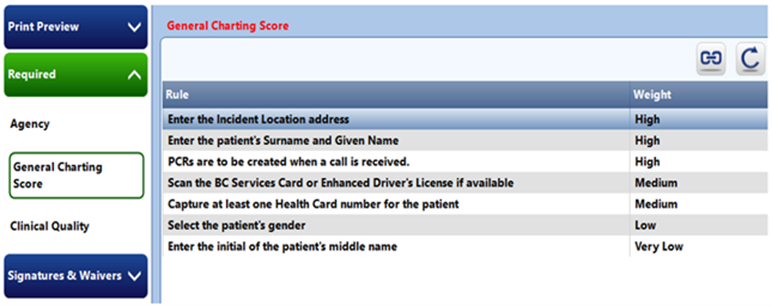
PCRs are dynamically scored as information is entered into the PCR. The current score will be indicated by a simple color code. Red and Yellow indicate the PCR has room for improvement, while Green indicates an excellent level of completeness. As the user progresses through the list and makes amendments, the color will change from red to yellow to green. Unlike Mandatory fields, the ICARES section is an optional tool for improving documentation standards. Every ePCR you create generates an individual score for you to review before finalizing.
Peer ePCR Evaluation & Resources (PEER): This innovative collaboration between the Practice & Learning and Employee Health and Wellbeing teams is designed to elevate the professional standards of paramedics. The team consists of paramedics from the Connect & Recover (CAR) program or those on a Duty to Accommodate (DTA), all of whom have recent experience at various levels of paramedic practice, including Primary Care Paramedic (PCP), Advanced Care Paramedic (ACP), Critical Care Paramedic (CCP), or Infant Transport Team (ITT).
This collaborative project aims to support paramedics throughout their professional development, promoting excellence in practice while prioritizing their health and wellbeing. If you receive an email from the PEER team with documentation recommendations, please know that this is part of a quality improvement initiative—not a disciplinary action. The feedback and resource links provided are intended to help you strengthen your documentation skills and expand your knowledge.