Confirmation
Active Deadly Threats
Reviewed December 2025
Under no circumstances are BCEHS Paramedics authorized to be deployed in the Direct Threat / HOT Zone
Introduction
Tactical emergency care addresses medical management in high-threat, unstable, or nonconventional environments where standard EHS operations may not safely or effectively apply. It extends beyond routine prehospital care by incorporating threat mitigation and operational constraints into clinical decisions.
Given evolving threats, the Committee for Tactical Emergency Casualty Care (C-TECC) framework includes specialized approaches for dual-injury and toxic exposure scenarios via a dedicated guidelines, these have been used as a framework to support BCEHS. This guideline is intended for BCEHS Paramedics to adapt these principles to British Columbia’s operating environment, and to ensure consistency, safety, and clinically sound care in tactical settings.
General
This CPG defines principles, recommendations, and operational considerations for BCEHS Paramedics providing care in high-threat, or hazardous environments. It overlays the standard BCEHS protocols when risk or scene dynamics deviate from conventional EMS settings. The guidance draws primarily from the C-TECC ALS/BLS guidelines and the CBRN annex, adapted for regional practice and scope and licensed for BCEHS use.
Guiding Principles
- Responder safety and threat mitigation first — Standard medical care will only occur in the Cold Zone.
- Focus on time-sensitive, life-saving interventions — Hemorrhage control, airway stabilization, transport to appropriate facilities and prevention of physiologic collapse receive priority over non-critical procedures. All management in the Cold Zone may be per all current CPG only if resources and equipment allow.
- Evidence-based where possible, consensus otherwise — Where high-grade evidence is lacking, expert consensus informs guidance.
- Scalable and context-sensitive application — Recommendations can be tailored by incident type, resource availability, provider training, and local protocols.
- Phased care based on threat environment — Interventions are structured around Direct Threat, Indirect Threat, and Evacuation phases, rather than rigid zones. The situation will always be dynamic.
Threat Zones
- Hot Zone (Direct Threat)
- The area where there is an immediate and ongoing threat to life, allowing only life-saving actions like hemorrhage control and rapid evacuation.
Example: An active shooter is still firing inside a building, responders must take action to hide if they cannot run.
- The area where there is an immediate and ongoing threat to life, allowing only life-saving actions like hemorrhage control and rapid evacuation.
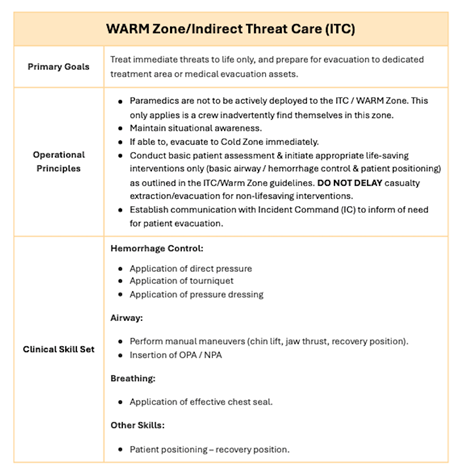
- Warm Zone (Indirect Threat)
- The area where the threat has been suppressed or contained, but danger still exists; limited medical care can occur with tactical awareness.
Example: The suspect has fled or been contained in another part of the building, but the scene hasn’t been fully cleared - BCEHS responders must evacuate to the cold zone.
- The area where the threat has been suppressed or contained, but danger still exists; limited medical care can occur with tactical awareness.
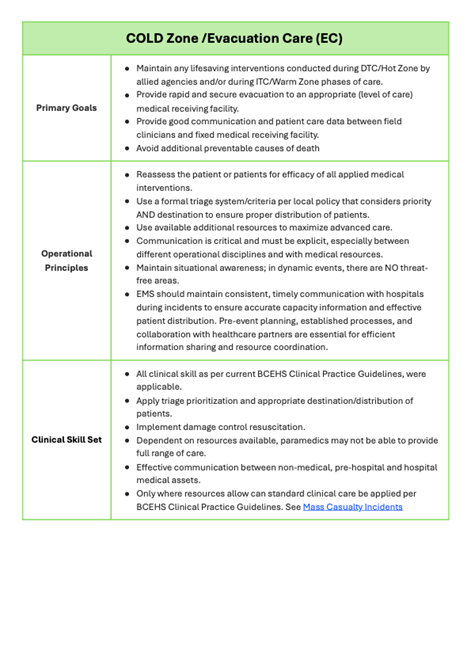
- Cold Zone (Safe Zone)
- The area deemed secure with no active threat, allowing comprehensive patient assessment, treatment, and triage.
Example: A designated casualty collection point (Or Ambulance Exchange Point) outside the incident perimeter where law enforcement has established full security. In a non-MCI situation, paramedics in the Cold Zone can perform full secondary surveys and provide comprehensive treatment before transport. In an MCI, care is limited to essential interventions and rapid preparation for conveyance to preserve resources and manage patient flow.
- The area deemed secure with no active threat, allowing comprehensive patient assessment, treatment, and triage.
Limitations & Assumptions
- The CPG assumes integration with BCEHS’s existing medical oversight, command structure, and EHS guideline framework.
- It is not meant to replace standard EHS care in low-threat or conventional settings, but rather to supplement or modify care when circumstances demand.
- Some recommendations derive from limited or consensus-level evidence; continuous review and revision will be necessary as new data emerge.
- In CBRNE and hazardous environments, additional constraints (e.g. donning PPE, required decontamination, limited MCM supply) must be factored into risk-benefit judgments.
- For High Risk Hazard support, consult the HRH Guide in the Handbook.
- For Mass Casualty Incidents & Triage, consult Mass Casualty Incidents in the Handbook
Under no circumstances are BCEHS Paramedics authorized to be deployed in the Direct Threat / HOT Zone
Interventions